Monday, October 31, 2011

Bill Bourne at The Pearl Company

It was a Saturday night, and I was home alone. The car accident I had been in the night before had left me a bit shaken. I only broke a fingernail, but I was having trouble settling. I thought about skipping out on the plans I had made to go to the Pearl Company to see Bill Bourne. It was starting to rain. Ah what the heck, I decided to go. A couple hours of live music could only help me feel better.
I made the right decision.
The Pearl Company is, just as it sounds, a gem in the middle of Hamilton. It's like a pearl, it doesn't sparkle diamondlike in the sun, but when the sun goes down the Pearl has an inner glow that warms the heart. Too bad more people don't take advantage of it.
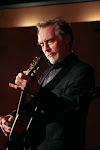
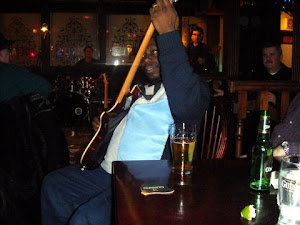
While there are seats for almost 150 only a third of those were filled when Alberta's Bill Bourne took the stage Saturday night. He played an old blues on his battered Gibson. Then he called for the band, the Free Radio Band, to join him. Switching between the Gibson and a Martin (tuned to an open chord) he led the band through a career stretching journey. Moses and Brian on bass and drums comprised the solid rhythm section and Pa Joe (from Ghana by way of Toronto) played smooth jazzy guitar fills on his Stratocaster.

While the music was extraordinary, I really want to use this time to comment on the Pearl Company itself. As I walked up to the door Gary Santucci was on the street with a flashlight helping to park cars. Once inside Barbara Milne greeted me with, "Hi, David, it's been a long time!" How many venues provide this kind of personal service?
The merch table is right in front of you, with Bill Bourne sitting alongside playing his guitar warming up. A coffee pot brews on another table, which features tasty treats. Try the butter tarts! The walls are filled with art and photography. The performance area is behind a curtain. The seats are a collection of different chairs, a couple of couches, two banquettes...choose the most comfortable, the sightlines are all good, the sound is exquisite.
Barbara and Gary use the building for a variety of purposes. The first floor can be an art gallery, although Saturday night it looked like it was setup for a theatrical performance. The second floor is the concert hall. They live above that in a huge open space. It's called the Pearl Company because it used to be a factory where they made pearls. You can still see them ground into the wooden floors! But it will be the Pearl Company...the essential gem in Hamilton's treasure chest of entertainment. These people are committed to the arts, and to the city. If only the city was committed to them!
On Saturday night John Mellencamp was playing at Hamilton Place, Selena Gomez was at Copps Coliseum, Malawi singer guitarist Tony Bird was at Artword ArtBar, and the Pearl had Bill Bourne. Hamilton has a place in the cultural fabric of Southern Ontario, and The Pearl Company offers a gorgeous intimate venue that we should all use more often!
Here's the schedule for November!
November 4: Jazz w Andy Middleton Group
November 4: Art Bus
November 8: Jazz w Ernesto Cervini Quartet featuring Joel Frahm-
November 9: Emm Gryner & Colleen Brown
November 10: Rakish Angles
November 11: Art Bus
November 12: Kaleidoscope Brown: Brownman w Latin Jazz
November 17: Cam Penner
November 19: Ben Caplan w Charlotte Cornfield
November 22: Jenn Grant w Amelia Curran
November 24: Matthew Barber w Louise Burns
November 25: Jazz Connection Big Band w Paul Hoffert on Keyboards
November 26: Jon Brooks
November 27: Design Hope CD Launch

Wednesday, October 19, 2011

Q. and A.: Ry Cooder on Woody Guthrie, Politics and a New Album


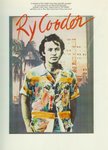
Ry Cooder’s been called a lot of things: A “musician’s musician” and a “musical archeologist;” a virtuoso of rock and blues guitar; and an explorer of international styles. But no one has ever labeled Mr. Cooder, 64, a folksinger. No one has accused him of singing protest songs and serving up social commentaries in the tradition of Woody Guthrie, Pete Seeger, Phil Ochs or Bob Dylan. Mr. Cooder’s most recent album, Pull Up Some Dust And Sit Down (Nonesuch), may change that perception.
It is an overtly political work rooted in his anger over the country’s financial collapse, the bailout of America’s big banks and what Mr. Cooder feels are senseless wars. Employing everything from Mexican country music to rock licks, he has written a series of scathing protest songs aimed at Wall Street bankers, Republican politicians, former President George W. Bush, anti-immigrant vigilantes and war profiteers.
The first track, “No Banker Left Behind” — a stomping old-time, jug-band tune — paints an image of bankers fleeing the country after “they robbed the nation blind.” Then Mr. Cooder sings a Mexican waltz-time ballad about Jesse James, in which the Missouri outlaw asks God for his gun back so he return to earth from heaven and take revenge on the bankers. “You lined your pockets well but I’ll see you all in hell,” Jesse James says before opening fire. Other tracks are political satire: in one growling blues tune, the devil is working as a political consultant for the Republican Party.
Mr. Cooder spoke by telephone recently from his home in Santa Monica, Calif., about his new album and how it came about. Here are edited excerpts of the conversation:
Q.
Why do you think more musicians aren’t writing protest songs these days?
A.
I myself am not in touch with anybody, you know. I’m a hermit. I stay in my home pretty much you know and I sit in my chair and I do this because it’s what I like to do. There are a lot of people out there, playing instruments, more than ever before for sure, and they’ve got to be saying something. They must be. We may not get to hear them.
Q.
Is it risky for artists to take on such material?
A.
I don’t know what risk it would be honestly. Risk of what? They can’t keep you off the radio because you’re not on the radio. You’re not going to be on the radio.
Q.
This album plays with some themes you developed in Chavez Ravine and My Name Is Buddy. But those were concept albums about times past, and this one is about current events.
Q.
What changed?
A.
If you look at the Buddy record, the Buddy record could be about now. It was in the style of then, a more archaic style I suppose. Modest because it’s a cat speaking. We all know how cats think.
Q.
That album recalled the labor songs of the 1930s. Do you see parallels between the 1930s and today?
A.
Well, sure. It’s only obvious, isn’t it? You can’t find solidarity in this country anymore and that was the saddest thing. It was what I had in that mind when I made that record. Especially with this voting business, about how they want to restrict voting and go back to Jim Crow time. That’s the most appalling thing of all. What else can you do but respond to this? Otherwise they paint you in the corner, you get angry and it’s very bad for your mental health.
Q.
There has been a nod to social justice in your work, going back to your 1970 debut album, when you covered Guthrie’s “Do Re Mi.” Does this sort of music hold a special place in your heart?
A.
I always loved those songs. Woody Guthrie – I probably first heard him when I was 5. And those records and those photographs – the Farm Security Administration photographs – they made a big impact. I was intrigued by his voice. Of course, the guitar interested me. I was trying to learn them when I was a little kid. Somebody gave me a guitar. Gave me the Woody Guthrie records too. It was quite a package.
Q.
What do you hope people will take away from this album?
A.
I’ve always said I’m just a guitar player from Santa Monica. I really believe that’s true. But I think that music has a contribution to make and if you ever saw Pete Seeger take a whole room and transform it into a collective mind, you know, where he could produce solidarity by making people sing with him, in four minutes, and it was a tremendous thing to witness. If you want to say do I think this is going to make an impact? I have no idea. I just do this because I like to do it.

By JAMES C. MCKINLEY JR. (originally published in Arts Beat, The New York Times)

Thursday, October 13, 2011

Ry Cooder, Los Angeles Stories (City Lights Noir, 2011)


Ry Cooder has written a book! Everybody’s go-to guy for bottleneck guitar has decided to write stories. He spent the first 20 years of his career navigating the history of American music. Then he worked for the movies. After that he helped the world rediscover Cuban music, he introduced us to the Okinawa sound, to the guitars of Timbuktu. More recently he wrote and performed a trilogy of albums about California. Chavez Ravine told the tragic tale of a community of Mexican-Americans, who were moved out of their neighbourhood to make room for Dodger Stadium. Then My Name Is Buddy presented us with a fable of a cat named Buddy in a Guthrie-esque odyssey through the Depression. This was followed by I, Flathead, which came packaged in a hardbound book which featured the lyrics to the songs, along with a novella to flesh out the stories. On a rare tour of Europe with son Joachim on drums and Nick Lowe on bass and vocals, the ‘merch counter’ offered t-shirts, posters and a hard cover book called Los Angeles Stories. The book came signed or unsigned. My copy was bought for me in Barcelona and mailed at great cost (the stamps covered the front of the envelope as well as the postage). Now two years later the book has been published in a popular trade paperback edition, by San Francisco’s City Lights Books.


There was certainly a sense of place and time in the tale of a door to door salesman who gets involved in a mystery by circumstance. It was a bit like a Raymond Chandler story. Maybe not as cleverly plotted, but rich in language, character and the essence of 1950's LA. Each tale has a title and a date, and early to mid-50s seems to be Cooder's oeuvre. Some of the stories echo each other as characters (or at least names) reappear. The links are tenuous except that they all take place in the City of Angels and all involve people involved in shadowy activities -- musicians, gun shop owners, pornographers, thieves, and all sorts of women.

Although it’s based on the kind of hard-boiled style of Chandler and the like, Cooder has his own voice, and if he had started writing sooner, might have made a bigger splash in the literary world. It might be too late for that. Bravo to City Lights for taking him on, and introducing him to a broader audience.
Who’s in that audience? Well, obviously, Ry Cooder fanatics will have to get a copy. Fans of hard-boiled fiction might want to give it a try, and anyone interested in the city itself, will find much to savour. The limited edition hardcover is all gone but the paperback edition is available anywhere books are sold.

This review has been updated from a review of the hardcover edition which appeared in Green Man Review.

Thursday, September 8, 2011

The Beatles Tribute at Hugh's Room...


It's a long drive from stately Rylander Manor to the Big Smoke, especially on a Friday evening, of a long weekend. Nonetheless my wife and I made the trek, and considering everything...it was a fairly simple journey. A Man Called Wrycraft had invited us to attend TWIST & SHOUT the second annual tribute to the Beatles. The poster is fantastic, using imagery from HELP! to advertise this homegrown show.

Walked into the room and there was Michael, who waved us over and in his booming voice said, "David...didn't you have a hat on the last time we met? Meet Gurf Morlix!" Two minutes in and I'd been introduced to Gurf Morlix...not bad. After a brief chat (and an autograph) we took our place at the next table and ordered dinner. Pasta and sausage for me, beef stroganoff for Milady. The food at Hugh's Room is not bad, but I think their menus could use an update.

The show started at 8:30 with the sound of the pipes from the bar. That's right...THE PIPES! Bagpipes, played by Grier Coppins, leading the Highland Brothers in a spirited version of George Harrison's sitar masterpiece, "Within You, Without You". Pipes, drum and sax marched to the stage, the tune melding into "Rain". Then the pipes and drum were laid down and replaced by guitars for "Hey Bulldog" and more. Then more pipes as the trio retreated to the bar. Michael introduced Aaron Jensen and the Omnium Gatherum who sang "In My Life" and "Got to Get You Into My Life" in guitar accompanied vocalese. Lovely. They were followed by a bluesy "Yesterday" and "Yer Blues" from Alfie Smith and Nicole Christian. Interesting, if a bit awkward. "Yesterday" doesn't really lend itself to blues scales. Next up, Toronto producer/guitarist Ray Montford who did weird things to "Girl" and almost redeemed himself with an instrumental "Come Together".

After a brief intermission the music began again with David Celia bravely tackling "Happiness Is A Warm Gun" and "A Day In The Life"! Awesome really! The Indo-African trio Sharbat was up next with long renditions of "Let It Be" and "Eleanor Rigby". World Music rules. Gurf Morlix, who had been watching and enjoying the show with the rest of us, then took the stage. He played "From Me To You" and Ringo's "Don't Pass Me By" as if they were Townes Van Zandt songs! I would've loved to hear a whole set by him...maybe next time.

That left Saidah Baba Talibah and Donna Gratis to finish the night. Saidah's voice and Donna's guitar were magical, adding soul to two tunes from Abbey Road. "You Never Give Me Your Money" and "I Want You/She's So Heavy" both sounded great. Then Michael called the whole cast back to the stage for a singalong on "Don't Let Me Down". It was fun! The whole audience got involved. In fact the audience was just dying to get involved and would have happy sung along at any point during the night.

Then it ended. We wandered into the night. Drove home and dreamed of John, Paul, Ringo and George. A great evening. Thanks Man Called Wrycraft, thanks a lot!

Friday, September 2, 2011

Reviews are in for Ry's show in SanFran...

I've heard a lot of friends complain that living in San Francisco comes with a steep cover charge. While that is true, many notable artists have a particular affinity for the Bay Area's unique venues and personalities. With that high cost of living comes the opportunity to experience art and culture that can be found nowhere else in the world.

Such is the case with Ry Cooder's current stint at the Great American Music Hall. The shows are primarily intended to announce the release of his latest album, "Pull Up Some Dust and Sit Down," but more than that he wanted to bring his San Francisco audience, who he applauds for their appreciation of the new and unexpected, something that in his words "they don't get to see every damn day." There will be no tour to follow this two-night run and on Wednesday fans came from as far away as Florida and Wisconsin.

The band brings together Cooder's past and present, featuring a rare appearance by accordionist Flaco Jimenez as well as singers Terry Evans and Arnold McCuller, all veterans of Cooder's touring bands from the '70s and '80s. The rhythm section represents the younger generation with son Joachim Cooder on drums and Los Angeles based-singer/songwriter/multi-instrumentalist Robert Francis on bass. The core configuration is augmented by a ten-piece horn section including tuba and bass-saxophone, many of whom are positioned in the balconies on either side of the stage.

The Wednesday set spanned Cooder's career highlighted by a spirited version of Woody Guthrie's "Do Re Mi" featuring Jimenez's deft accordion work, a romping boogie-woogie rendition of Sam the Sham's "Wooly Bully," and a whole lot of down home blues and Mexican-tinged traditional songs.

Cooder's new material from "Pull Up Some Dust" was well received by the left-leaning San Francisco audience who seemed to particularly enjoy "El Corrido de Jesse James," a modern-day fable told as a conversation between the outlaw and God. Jesse James asks for his gun back so that he can return to Earth to shoot up Wall Street and "set things straight," naive to the reality that America's problems can no longer be solved with grit and bullets. "No Banker Left Behind" began a two-song encore again using satire to illustrate Cooder's concerns about American political and economic policy.

Time has been kind to Cooder's voice. His vocals have matured over the course of his career and he has learned how to use his singing to convey the spirit of his more recent work which is more lyrics-driven.

Joachim Cooder was solid with good feel and held down the rhythm effectively. The bond between father and son was evident and could be felt in the music, although at times Jim Keltner's wider breadth of expression and rhythmic mastery was missed. Francis' bass playing was enthusiastic and functional although there were moments when he seemed to be just hanging on and unsure where certain songs were going.

The horns were sonically magnificent and added a new dimension to the material but at times overpowered the band and were overwhelming, bordering on painfully loud, which Cooder seemed to enjoy tremendously.

Even with so much sound and so much to look at, the most transcendent moments were when slide hit steel. Cooder is a true master of the guitar and every time he took the lead the music was elevated to a higher level. Though firmly rooted in slide blues, his playing defies genre classification and can only be compared to a handful of other living masters who share his dedication to the eclectic. Guitarists Bill Frisell, Pat Metheny and Mark Ribot jump to mind.

San Pablo's Los Cenzontles (The Mockingbirds) opened the evening with a richly authentic and spirited set of traditional Mexican-influenced dance songs to the delight of the crowd.

Both shows are sold out, but a number of fans were looking for tickets at the door on Wednesday night and most seemed to find their way in. For the dedicated, it might be worth a trip downtown to see if you can get lucky on Thursday. You won't get many, if any, more chances to see this ensemble. Only in San Francisco.
(from SF Gate)

Thursday, September 1, 2011

New interview with Ry Cooder...

This appeared on CANOE today!

It feels like old times to Ry Cooder. And that's the problem.

Economic malaise, unfettered greed, spiralling unemployment, self-serving politicians, impotent media: Life in America hasn't been this depressing since ... well, the Great Depression, the veteran singer-guitarist and musicologist believes.

"It's only perfectly obvious," grumbles the ornery 64-year-old Cooder from his Santa Monica home. "I read history books. I know what this is all about. I'm not stupid. What we have now is a replica of those conditions. Politicians in general and corporations have manipulated and wrecked the country. As a nation, we've come full circle entirely."

Fittingly, so has he. Cooder's latest album Pull Up Some Dust and Sit Down harkens back to his '70s heyday, when he specialized in unearthing and revamping Depression-era fare like "How Can a Poor Man Stand Such Times and Live?" and "The Very Thing That Makes You Rich (Makes Me Poor)". This time around, however, Cooder's timeless tracks -- a musical melting pot of folk, blues, country, Tex-Mex, gospel, soul and more -- are topped with his own topical lyrics about everyone from bankers and brokers to illegal aliens and John Lee Hooker. It may be the most personal and potent album of his career; no small feat for a guy whose resumé includes more than a dozen acclaimed solo albums, a slew of magnificent Hollywood soundtracks and collaborations with everyone from The Rolling Stones and Captain Beefheart to Buena Vista Social Club.

With Pull Up Some Dust now in stores, Cooder made some time to talk about creeping up on Woody, the kids and their texting, and how he soothes his jangled nerves.

Most artists go from angry young man to aging gracefully. You're getting feistier.

Ha! Not really. But I see what you mean. When you're surrounded by all these criminal acts and this terrible devolution of political life and social structure here in America -- I don't how it must seem up there, but down here, at my age, you can certainly trace this arc of collapse and chaos -- what are you going to do? It was either die of frustration and bitterness or make something out of it, you see. It's bad mental health to let that overtake you.

But you came up in the '70s during Watergate and Vietnam, and didn't write about them. What's different?

It took me a long time to get to where I had a handle on songwriting. You know, the old populist music of the '30s, which was invented and written by working-class people, was used to describe their lives and what they were going through, whether you were on strike at the cotton mill or westward-bound on the road. But since I didn't migrate west with the Dust Bowl guys like Woody Guthrie or see this first hand, I had to creep up on it more. It took time to absorb that kind of songwriting. It's taken me ... well, a lifetime.

Does it rankle you that protest music seems dead?

Well, here's the thing: In the '70s, you had one huge difference, and that was the record business. You had the three Rs: Radio, records and retail. You had a quick-response system. You could write a song and could go into a studio -- in those days, you still did that too -- and the record company could put it out as a single pretty quickly.

You could do that today on the Internet.

Oh, I don't think it's the same. The Internet is so vast and so diffuse. You can't compare that to the record business and the way it worked. And digital cyberspace doesn't provide a shared experience. I used to go see Pete Seeger, and within minutes he'd have an entire audience singing. When people sing together, they feel the same thing, they feel kinship. And by the end of the song, they've learned something and they can be moved forward. It's hard to have this kind of experience now; that feeling of solidarity.

Speaking of performing, you haven't done much lately. Why not?

It's hard. I'm a homebody. Travelling was not my favourite thing. And it's very difficult to do music out in the world. It's the most random, odd feeling. But I'm starting to think people are ready for this message. I don't know about the youth with their texting; they're hypnotized by their little screens. But they don't come see me anyway unless their grandparents bring 'em. But I think older people will respond to this. So if that means I go and play for 150 people -- which I think is an ideal audience -- to get this message across and give them the feeling I want them to have, I'm happy to do it. We're going to try a couple of shows this month. We'll see if I can pull it off. If it's motivating, maybe I'll find a friendly billionaire who will underwrite the whole thing.

I find it reassuring that your music has retained its own sound. You've never chased a trend.

Heaven forbid. I wouldn't even know a trend to chase.

What kind of music do you listen to?

Classical. It's very spacious and undemanding, especially the French guys. I like Ravel and all those cats. It's very soothing to my jangled nerves.

darryl.sterdan@sunmedia.ca

Thursday, July 21, 2011

So, what have I been up to?

I took a couple of weeks holiday. Played my guitar[s], read some books, watched a bit of TV. It was relaxing.
I read Jeffery Deaver's up-date on James Bond, Carte Blanche, and found it to be a satisfying, exciting story. Good settings, interesting characters, and a villain who was...disturbed to say the least. Better than some of the post- Ian Fleming Bonds. Then I read Joe Gores' Spade and Archer the prequel to Dashiell Hammett's The Maltese Falcon. Gores had also written Hammett which saw the writer drawn in to a detective story not unlike his own work. Gores is a strong writer, and so his take on Sam Spade is respectful of the original and builds him into the detective that Hammett introduced. Of course, most people recognize Spade as Humphrey Bogart, and those folks won't be disappointed either. Another fun read.
Also got a look at Julian Dawson's biography of rock's sessionman extraordinaire. And on piano...Nicky Hopkins gets my full attention on Sleeping Hedgehog, but let me tell you, it's a dynamite tale.
I went to see Richard III at Stratford which featured Seana McKenna in the title role. It's been a tad controversial but I have to say she totally convinced me that she was a miaserable crippled king!
We also visited Toronto's Sound Academy to see Leon Russell. Paul James opened the show for some rocking blues and then Leon and his band really rocked the place with a career overview. See my full review on the Critics at Large blog!
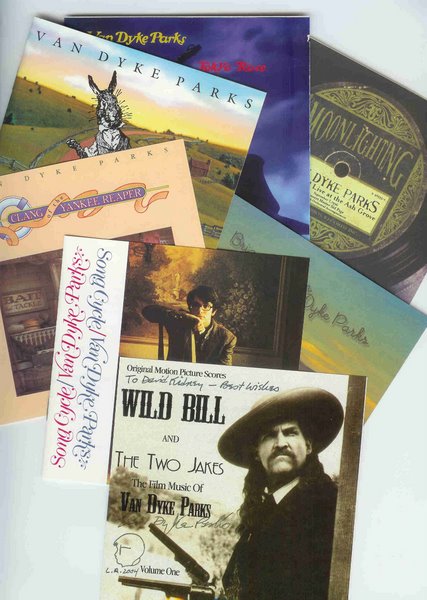
New music? Blackie & the Rodeo Kings Kings & Queens, Gillian Welch's new one, and a bunch of Jack White produced 45s from Third Man Records. Vinyl? Yes, vinyl. I've been buying vinyl because, I can read the liner notes! See also Van Dyke Parks' new website, Bananastan, for subscription information. The music is beautiful, as is the presentation. Great artwork.
Friday night we celebrated Dr. Disc's 20th Anniversary by attending one of their free rooftop concerts. The Steve Strongman Band gave us forty-five minutes of blues in the Hammer. It was a gorgeous night...